The Ehsaas Rashan Program 2026 is a Pakistani government initiative providing subsidized food staples — flour, sugar, cooking oil, and pulses — to low-income households. Registration is open to eligible citizens with a valid CNIC, and eligibility can be verified instantly via SMS 9999, SMS 8123, or the official online portal, all completely free of charge.
Pakistan's inflation crisis has pushed millions of households to the financial edge. The government's response, through the Ehsaas Rashan Program, is one of the most direct interventions available: subsidized essential goods distributed through utility stores and registered grocery retailers across the country. For 2026, the program continues with a strengthened digital verification backbone, making registration more accessible and more transparent than before.
But knowing the program exists is only half the battle. Understanding exactly who qualifies, how to register, and what pitfalls to avoid — that's where most applicants struggle.
Ehsaas Rashan eligibility criteria in 2026
Not every Pakistani household qualifies for the Ehsaas Rashan subsidy. The program targets families living below the defined poverty threshold, and the government uses a combination of national database cross-referencing and CNIC-based identity verification to filter applications.
Who meets the basic requirements
The core eligibility conditions are straightforward. An applicant must:
- Hold Pakistani citizenship
- Possess a valid CNIC (Computerized National Identity Card)
- Have a household income that falls within the government's poverty threshold
- Not receive a high-level government salary
- Not own significant assets or registered businesses
The last two points disqualify middle-class and upper-income households from accessing the subsidy. The program is explicitly designed for low-income families who struggle to afford basic food items at market prices. If a household has previously registered under related welfare programs like the BISP (Benazir Income Support Programme), that data may already be linked to their CNIC in the national system.
The CNIC-based verification system is connected to national databases, meaning eligibility is determined automatically based on existing government records — not self-declaration alone.
Why digital verification changes the process
In previous years, subsidy distribution was plagued by manual errors and leakage. The 2026 Ehsaas Rashan registration process relies on a digital verification system that cross-checks applicant data against national records in real time. This reduces fraud and ensures that subsidies reach genuinely eligible families. Concrètement, it also means that incomplete or inaccurate information will trigger delays or outright rejections — a recurring problem that applicants must take seriously.
How to check your Ehsaas Rashan eligibility
Before attempting to register, every applicant should verify their eligibility status. The government provides three distinct methods, all free of charge.
Checking eligibility via SMS
The SMS route is the fastest option for most Pakistanis, requiring nothing more than a mobile phone registered in the applicant's name.
Via SMS 9999:
- Open the SMS application on your phone
- Type your CNIC number without spaces or dashes
- Send the message to 9999
- Wait for the system's automated response
Via SMS 8123:
- Send your CNIC number to 8123
- Wait for the response
- If eligible, follow the instructions provided in the reply
Both services return an automated message confirming eligibility or indicating that the number is not registered in the system. The 8171 code is also connected to the broader government welfare infrastructure and may be referenced for related benefit inquiries — for instance, those already familiar with the BISP 8171 web portal will find the process structurally similar.
Checking eligibility through the online portal
For applicants with internet access, the official Ehsaas government portal offers a more detailed verification process:
- Visit the official Ehsaas registration portal
- Enter your CNIC number in the designated field
- Complete the security verification step
- Submit the form and wait for the eligibility result
The portal is particularly useful for households that want to review their submitted household details or confirm that their information is correctly recorded in the national database.
Only use official government portals and SMS numbers. Avoid third-party websites or individuals claiming to guarantee eligibility — these are common scam vectors targeting welfare applicants.
Completing the Ehsaas Rashan online registration
Once eligibility is confirmed, the actual registration process can begin. The 2026 online registration follows a five-step procedure that requires accurate household data.

Step-by-step registration process
- Visit the official Ehsaas registration portal
- Enter your CNIC number exactly as it appears on your identity card
- Provide complete household details — number of family members, income information, and residential address
- Submit the completed form
- Wait for the system to process and confirm eligibility verification
The system does not provide instant confirmation of registration approval. Processing times vary depending on database load and the completeness of submitted information. Applicants who submit accurate, complete data consistently experience fewer delays.
Common registration problems and how to avoid them
Several recurring issues cause registration failures or delays. The most frequent ones are:
- Incorrect CNIC number — even a single digit error causes the system to reject the application
- Incomplete household information — missing family member data or income details trigger manual review delays
- Unregistered mobile number — the SMS verification requires a phone number registered under the applicant's own name
- Database verification delays — occasionally, national database backlogs slow down eligibility confirmation
Avoiding these problems is largely a matter of preparation. Double-check the CNIC number before submitting. Ensure all household members are accurately listed. Use a mobile number that is formally registered to you — borrowing a family member's phone may work for the SMS check, but the number must be linked to your own identity for the process to function correctly.
All eligibility checks — whether via SMS 9999, SMS 8123, or the online portal — are completely free. Never pay anyone to check your eligibility or register on your behalf.
What Ehsaas Rashan subsidies cover and where to collect them
Registration is the gateway. But understanding what the program actually provides, and where to access it, is what makes it practically useful.
Subsidized food items under the program
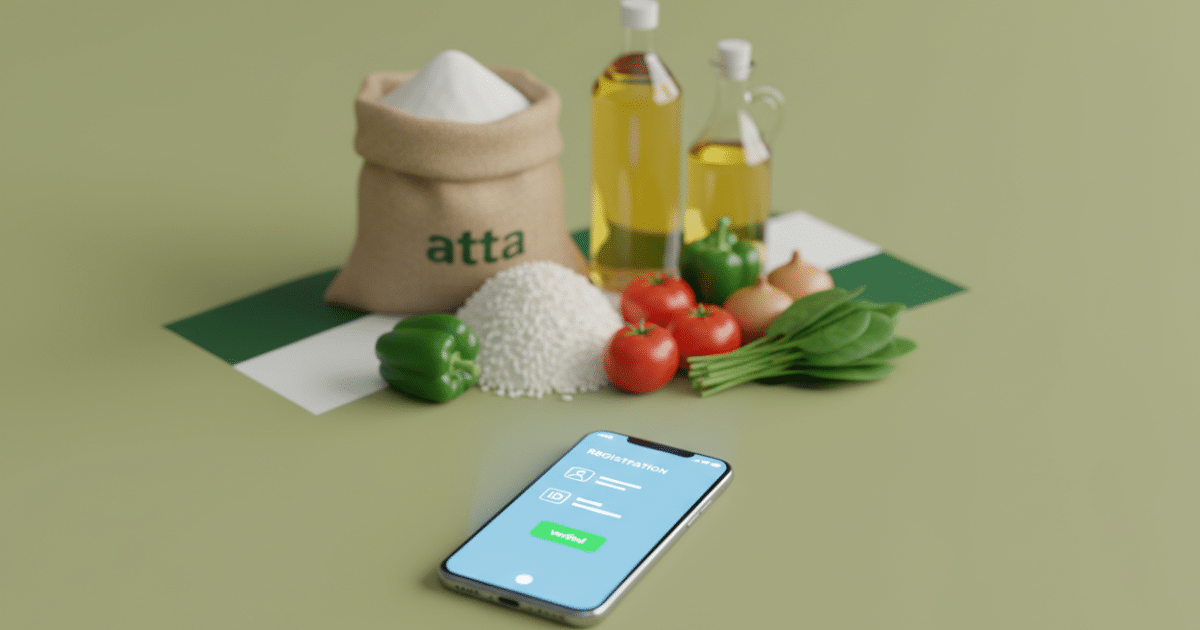
The Ehsaas Rashan Program covers four core essential food categories:
- Flour (atta)
- Sugar
- Cooking oil
- Pulses (legumes/lentils)
These items were selected specifically because they represent the largest share of food expenditure for low-income Pakistani households, and because their market prices have risen sharply due to inflation. By subsidizing these staples, the program directly reduces the monthly financial burden on registered families.
Distribution points across Pakistan
Registered beneficiaries access their subsidized goods at utility stores and participating registered retail grocers across Pakistan. The distribution network is geographically spread to ensure accessibility in both urban and rural areas. Beneficiaries are typically notified of their nearest distribution point after successful registration.
essential food categories subsidized under the Ehsaas Rashan Program
The digital backbone of the program means that each transaction at a distribution point is recorded and verified against the beneficiary's CNIC, preventing duplicate collection and ensuring transparency. This accountability layer is one of the most significant improvements in the 2026 iteration of the program compared to earlier manual distribution methods.
The broader impact of Ehsaas Rashan on Pakistani households
The program's effects extend beyond the grocery receipt. For families living at or near the poverty line, consistent access to subsidized staples translates into measurable financial relief. Monthly food costs drop, freeing limited income for other necessities like healthcare, utilities, or school fees.
Food security improves not just in volume but in predictability. Knowing that a portion of essential food costs is covered by government subsidy allows households to plan more effectively. And the shift to digital verification has made the program significantly more transparent than cash-based welfare transfers — a point that matters both for public trust and for program sustainability.
The 2026 phase of the program also intersects with other active welfare initiatives. Households already enrolled in related schemes may find their eligibility automatically reflected in the Ehsaas system. Those managing multiple government benefit applications — whether for food support, education stipends like Benazir Taleemi Wazaif, or the BISP Phase 4 payments — will find that the same CNIC-based infrastructure underpins all of them. Managing your utility accounts and government registrations through verified digital channels, whether for welfare programs or services like checking your electricity bill online, reflects the same principle: accurate data, registered identity, and official platforms only.
For any Pakistani household that meets the eligibility criteria, registering for Ehsaas Rashan in 2026 is a straightforward process — provided the application is submitted through official channels with complete and accurate information. The system is designed to be accessible. The responsibility for a clean submission lies with the applicant.