The BISP 8171 payment without biometric verification remains accessible in 2026 through four government-approved alternative methods. Beneficiaries facing fingerprint failures, expired CNICs, or technical errors can still collect their Rs. 13,500 quarterly payment by visiting a BISP Tehsil Office, updating biometrics at NADRA, using an authorized retailer, or appointing a family nominee.
Millions of low-income families across Pakistan depend on the Benazir Income Support Programme for survival. But what happens when the biometric scanner refuses to recognize worn fingerprints, or an ATM throws a technical error at the worst possible moment? The payment stops. The family waits. And without clear guidance, many eligible beneficiaries simply give up.
The Government of Pakistan has anticipated this problem. Multiple alternative pathways now exist specifically for cases where standard biometric verification fails, and the 2026 system improvements have made these options more accessible than ever.
Why biometric verification fails for BISP payments
Biometric verification sounds straightforward until it isn't. The reality on the ground involves a range of technical and administrative failures that affect a significant portion of BISP beneficiaries every payment cycle.
Physical causes of fingerprint mismatch
The most common reason is also the most overlooked. Elderly women, agricultural laborers, and domestic workers often have naturally faded or worn fingerprints due to years of manual work. The biometric scanner simply cannot read what is no longer clearly defined. Age alone causes fingerprint ridges to flatten over time, making even a standard NADRA-registered print difficult to match against a live scan.
Beyond physical wear, seasonal dryness, skin conditions, and minor injuries can temporarily alter fingerprint quality enough to trigger a mismatch. These are not fraudulent cases. They are ordinary beneficiaries whose physical condition creates a technical barrier.
Administrative and system-level failures
Expired or blocked CNIC numbers are another major source of payment failure. When a CNIC expires and the beneficiary has not renewed it, the entire payment chain breaks down. The system cannot disburse funds to an identity it cannot verify.
Technical errors at ATMs and payment center devices compound the problem. Device calibration issues, network outages, and software glitches can block a perfectly valid biometric from registering correctly. An incomplete BISP dynamic survey, which is required for continued eligibility, can also freeze payments regardless of biometric status. If you have recently experienced delays for reasons beyond biometric issues, the common reasons behind BISP payment delays are worth reviewing separately.
How to receive BISP 8171 payment without biometric verification
The government has established four distinct methods for beneficiaries who cannot complete standard biometric verification. Each method serves a different situation, and knowing which one applies to your case saves considerable time.
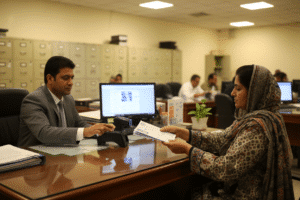
Method 1: Manual verification at BISP Tehsil Office
This is the most direct route for beneficiaries who face persistent biometric failure. The process requires:
- Bringing your original CNIC to the nearest BISP Tehsil Office
- Informing the staff about the specific biometric verification issue
- Undergoing manual identity verification by the officer on duty
- Receiving payment through an alternative disbursement method approved by the office
The Tehsil Office has the authority to override biometric requirements in verified cases of genuine failure. The key is presenting your original documents and being transparent about the nature of the problem.
Method 2: NADRA biometric update
For beneficiaries whose fingerprints have degraded or whose registration data is outdated, visiting the nearest NADRA registration center offers a permanent fix rather than a one-time workaround. The steps are straightforward: request a biometric update, provide your CNIC and fresh fingerprints, and wait for the BISP system to sync with the updated NADRA records. Once the sync is complete, normal biometric withdrawal resumes automatically.
This approach resolves the root cause rather than bypassing it. For a detailed breakdown of how to handle the technical side of this process, the guide on fixing BISP biometric verification issues online covers the full procedure.
Method 3: Collection via authorized retailer
BISP-partnered authorized retailers are present across most cities and villages in Pakistan. These agents can perform manual verification and disburse payments without a biometric scan. The critical step here is confirming the retailer is officially approved before handing over any CNIC details. Sharing your 13-digit CNIC number with an unauthorized agent creates serious fraud risk, and the 2026 system improvements specifically include enhanced monitoring to prevent exactly this type of abuse.
Never share your CNIC details with anyone who cannot confirm their official BISP authorization. Fraud cases involving unauthorized agents have been documented, and the government has strengthened monitoring in 2026 to address this.
Method 4: Family nominee collection
In special cases where the beneficiary cannot physically visit any payment point, a family nominee can collect the payment on their behalf. This requires presenting the original CNIC of the beneficiary, the nominee's own CNIC, and completing verification at a BISP office. The nominee method is designed for cases of illness, disability, or extreme geographic difficulty, and it requires formal office approval before any disbursement.
How to check your BISP 8171 payment status in 2026
Before visiting any office or retailer, every beneficiary should verify their payment status and eligibility through the official 8171 web portal. This takes minutes and confirms whether a payment is actually pending or whether an eligibility issue is blocking disbursement entirely.
Online check via the 8171 portal
The process for a BISP CNIC check 2026 is:
- Open the official 8171 BISP web portal
- Enter your 13-digit CNIC number
- Complete the verification captcha code
- Click Submit
- View your eligibility status, payment confirmation, payment amount, and payment center details
The portal will also display whether a Rs. 13,500 quarterly payment is ready for collection or whether there is a hold on the account. For the January 2026 payment phase and the December cycle, the portal reflects real-time disbursement status.
SMS check via 8171
For beneficiaries without reliable internet access, the SMS method remains available. Open your phone's messaging app, type your CNIC number without dashes, and send it to 8171. A reply message will arrive with your current eligibility details. If the SMS system is not responding, the 8171 SMS troubleshooting guide covers the most common fixes.
quarterly BISP payment available to eligible low-income families in 2026
Additional BISP and Ehsaas payments available in 2026
The Rs. 13,500 quarterly disbursement is the core BISP payment, but several additional programs run alongside it and use the same verification infrastructure.
Ehsaas Program and the Rs. 25,000 relief package
The Ehsaas Program operates as a related but distinct financial assistance initiative. Certain packages under Ehsaas reach up to Rs. 25,000, and eligibility can be checked through the same 8171 Ehsaas web portal using an identical process: enter CNIC, submit verification code, click check. The Bewa Sahara Card referenced within the broader program offers financial aid reaching Rs. 1,50,000 (Rs. 1.50 LAC) for qualifying widows.
Ramzan Package and subsidized food assistance
During Ramadan, the 8171 Ramzan Package provides additional financial assistance or subsidized food to low-income households. Eligibility for the Ramzan Package can be checked either via SMS to 8171 or through the online portal using the same captcha-based process. The Ehsaas Rashan Program runs parallel to this, providing subsidized food items through a separate distribution channel. For families interested in applying to the food assistance side of these programs, the Ehsaas Rashan registration process for 2026 provides a complete walkthrough.
A separate payment amount of Rs. 14,500 has also been referenced in post-Eid continuation phases, reflecting the government's ongoing expansion of disbursement amounts. The 9999 code serves as an additional SMS channel for complaint submission and eligibility verification, separate from the 8171 portal.
Keep your CNIC updated with NADRA, complete the BISP dynamic survey when required, only visit official BISP centers, never share your CNIC with unauthorized agents, and check your status through the 8171 portal regularly to avoid missed payments.
What the 2026 BISP system improvements mean for beneficiaries
The Government of Pakistan has announced a concrete set of improvements to the BISP infrastructure for 2026. Expanded payment centers are being rolled out across Pakistan, reaching communities that previously had limited access to official disbursement points. The 8171 web portal itself has been upgraded for faster CNIC verification, reducing the processing time between eligibility confirmation and actual payment release.
Additional support channels specifically for biometric failure cases have been added, which directly addresses the core problem this article covers. Enhanced fraud monitoring has also been deployed across the system, targeting the unauthorized agents and fraudulent middlemen who exploit beneficiaries during payment collection. The PRMRP 9999 Online Registration 2026 program exists as a separate relief initiative within this broader expansion, offering another avenue for low-income households to access government support.
For beneficiaries who have been waiting on delayed payments or struggling with persistent biometric issues, the 2026 improvements represent a meaningful shift in how the government handles edge cases. The system is moving toward fewer exclusions, faster resolution, and more points of access, which ultimately means more eligible families actually receiving the support they are entitled to.