The 8171 SMS service is Pakistan's official gateway for checking BISP payment status, but millions of beneficiaries report it stops responding during peak payment cycles. When the SMS fails, several verified alternatives exist — and knowing how to use them can mean the difference between receiving your payment on time or missing it entirely.
The Benazir Income Support Programme (BISP) serves as a financial lifeline for low-income families, widows, divorced women, persons with disabilities, and households without a stable income across Pakistan. At the center of this system sits the 8171 SMS service, a tool designed specifically for rural populations with limited internet access. But when millions of people send messages simultaneously at the start of a new payment cycle, the system buckles under the load. Errors pile up. Families panic.
Understanding why the service fails — and what to do about it — is what this article covers.
Why the 8171 SMS service stops working
The 8171 number is not broken in the traditional sense. The failures are almost always tied to predictable, structural causes that repeat every quarter when BISP Kafalat payments are released.
Network congestion during payment cycles
When a new payment cycle opens — as happened with the January 2026 disbursement — millions of registered beneficiaries send their CNIC numbers to 8171 at roughly the same time. The system was built to handle routine traffic, not the simultaneous load of millions of queries. Delays stretch from minutes to hours. Some messages never receive a reply at all.
This is not a malfunction. It is an infrastructure limitation that the Government of Pakistan has acknowledged through its push toward digital reform. The 2026 digital overhaul of the BISP system, including a shift from cash payments to bank and mobile wallet distribution, is partly designed to reduce this bottleneck over time. But for now, the congestion remains a real obstacle.
Formatting errors in the CNIC
A surprisingly large share of failed SMS queries has nothing to do with the network. Beneficiaries frequently send their 13-digit CNIC with spaces or dashes between digit groups — a format that the 8171 system cannot parse. The service expects a clean, uninterrupted string of 13 digits and returns no response when it receives anything else.
The fix is simple: send the number without any spaces, hyphens, or punctuation, and always use a registered SIM card linked to your own identity. Sending from someone else's SIM can also trigger a failed response.
Never share your CNIC or personal information with unknown agents claiming to check your BISP status. Unofficial SMS services and third-party websites impersonating the 8171 portal are active fraud risks.
Outdated BISP survey or CNIC data
Even when the SMS goes through correctly, some beneficiaries receive a message indicating their payment is unavailable or their eligibility cannot be confirmed. In most cases, this points to one of two administrative issues: an expired or unupdated CNIC with NADRA, or a BISP dynamic survey that was never completed or has become outdated. The National Socio-Economic Registry (NSER) determines who qualifies for payments, and if a household's data is stale, disbursements stop until the survey is refreshed.
How to check your BISP payment status when 8171 SMS is not working
When the SMS route fails, the BISP payment status can still be verified through three alternative channels, each suited to different situations.
Using the 8171 web portal
The most accessible alternative for anyone with a smartphone or internet connection is the official 8171 web portal. The process requires only a few steps:
- Open the official BISP 8171 portal in a browser.
- Enter your 13-digit CNIC number in the designated field.
- Complete the captcha verification displayed on screen.
- Click the "Check Status" button to retrieve your current payment information.
This method bypasses SMS network congestion entirely and tends to be faster during peak periods. If you want a more detailed walkthrough of the portal's features, the complete guide to the BISP 8171 web portal covers the registration and application process step by step.
Visiting a Tehsil BISP office or district campsite
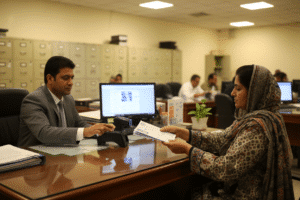
For beneficiaries in rural areas where internet access is limited — the exact population the 8171 SMS service was originally designed to serve — the physical route remains the most reliable. Bringing the original CNIC to the nearest Tehsil BISP office allows staff to manually verify eligibility and payment status on the spot. Many districts also operate BISP campsites that serve as payment distribution centers, particularly during active disbursement periods.
BISP offices can also initiate or update the dynamic survey on your behalf if your household data is outdated — a necessary step before any payment can be released.
Contacting the BISP helpline
A third option is calling the official BISP helpline directly. Agents can confirm your status using your CNIC number and guide you through any administrative issues blocking payment. This route works well when a physical visit is not immediately possible, though wait times can be long during active payment cycles.
The Rs. 13,500 Kafalat payment and what affects eligibility
The BISP Kafalat Program distributes payments on a quarterly basis. For 2026, each eligible household receives Rs. 13,500 per installment. This figure applies to the standard Kafalat cycle, separate from special relief programs tied to specific periods.

Eligibility for this payment depends entirely on the NSER survey results. Families who completed the survey and qualified receive payments automatically. Those who missed the survey, whose data has changed significantly (new income, change in household composition), or whose CNIC has expired may find their payments suspended.
per quarterly installment under the BISP Kafalat Program in 2026
The BISP March 2026 payment schedule provides updated release dates for the current cycle — worth checking if you are unsure whether your payment has been processed yet.
Beyond Kafalat, the government also runs supplemental relief programs during Ramadan. The 9999 SMS number handles cash relief queries for Ramadan 2026, while 8070 covers Punjab Nigehban rashan inquiries. The 13 February 2026 announcement simplified the Ramadan relief application process considerably. If you rely on these programs alongside Kafalat, the 9999 CNIC verification guide explains how to check your status for the Ramadan cash package.
What to do if your BISP payment is not showing up
A missing payment is not always a sign of disqualification. Several correctable issues can hold up disbursements, and most have straightforward solutions.
Complete or update the BISP dynamic survey
The BISP dynamic survey is the mechanism through which household data is refreshed in the NSER. If your family's circumstances have changed — or if you never completed the initial survey — payments will not be released until the survey is done. Visiting the nearest BISP office with your CNIC is the fastest way to initiate this process.
Update your CNIC with NADRA
An expired CNIC creates a mismatch between your identity records and the BISP database. NADRA handles all CNIC renewals and updates. Once the CNIC is current, BISP can match your records correctly and resume payments.
The shift toward bank and mobile wallet payments — part of the broader digital reform announced for 2026 — means that beneficiaries who previously collected cash will need to register their accounts with designated banking agents. Those already using mobile platforms like JazzCash or Telenor may find the transition smoother. Details on how BISP beneficiaries are receiving payments via JazzCash and Telenor are worth reviewing if your district has moved to digital disbursement.
Avoid unofficial channels
Fraud is a persistent problem around BISP payments. Unknown agents offering to "fix" your status, unofficial websites mimicking the 8171 portal, and SMS services pretending to be government tools all represent real risks. The government has issued repeated warnings on this. Always use the official 8171 portal, the official SMS number, or physical BISP offices. Never hand over CNIC details to individuals outside these verified channels. Checking what BISP has instructed beneficiaries after receiving their payment provides additional guidance on staying safe once funds are released.
The 8171 SMS service will continue to be the primary verification tool for millions of Pakistanis who lack reliable internet access. But it works best when used correctly — clean CNIC format, registered SIM, and outside of peak congestion windows. When it fails, the web portal, local offices, and the helpline fill the gap. Knowing the full picture means no single point of failure leaves a family without answers.